


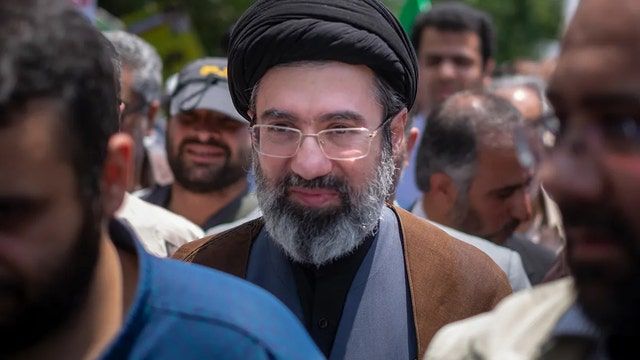
Washington DC — Donald Trump has declared he must personally be involved in choosing Iran’s next supreme leader, dismissing the frontrunner Mojtaba Khamenei, the late supreme leader’s son as a “lightweight” and drawing a direct comparison to his forced installation of a compliant government in Venezuela, as Iran’s Assembly of Experts prepares to announce a successor as early as Thursday.
“They are wasting their time. Khamenei’s son is a lightweight. I have to be involved in the appointment, like with Delcy in Venezuela,” Trump told Axios in an exclusive phone interview, referring to Delcy Rodríguez, who took power in Caracas in January after US forces seized and removed Nicolás Maduro.
“Khamenei’s son is unacceptable to me. We want someone that will bring harmony and peace to Iran,” Trump added.
The remarks represent an extraordinary public claim of American authority over the internal political future of a sovereign state the US is still actively bombing and directly contradict statements from Trump’s own Defence Secretary Pete Hegseth, who insisted earlier this week: “This is not a so-called regime change war.”
Mojtaba Khamenei: Who Is the Frontrunner?
Mojtaba Khamenei is 56 years old, a mid-ranking cleric, and has never held public office. He has deep ties to the Islamic Revolutionary Guard Corps and is regarded as a hardliner within Iran’s clerical establishment. He survived the US and Israeli airstrikes that killed his father on the opening night of Operation Epic Fury last Saturday.
Reports on Thursday suggested that Iran’s 88-member Assembly of Experts the clerical body constitutionally responsible for selecting a new supreme leader could make a formal announcement imminently, though no official confirmation has emerged. The IRGC is reported to have pressured the Assembly to elect Mojtaba despite resistance from some members.
Trump acknowledged Mojtaba is the most likely pick but made clear Washington will not accept the outcome.
“Most of the people we had in mind are dead,” Trump told White House reporters on Tuesday. “Pretty soon, we’re not going to know anybody.”
Israel Has Already Bombed the Body Choosing the Successor
Israel’s intervention in the succession process has gone beyond rhetoric. Israel bombed the building in Qom housing the clerical body responsible for selecting Iran’s next supreme leader on Tuesday, in a direct attempt to disrupt the vote-counting process, according to reports.
Israeli Defence Minister Israel Katz has already stated that Khamenei’s successor — regardless of identity — will be considered a legitimate target for assassination if he pursues hostile policies. The warning signals that Israel intends to treat the succession itself as a continuation of the military campaign.
The Venezuela Comparison — and What It Means
Trump’s reference to Venezuela is revealing. In January, US forces captured and removed Nicolás Maduro. Rather than backing the opposition long championed by Washington, Trump threw his support behind Maduro’s own vice president, Delcy Rodríguez — who has since cooperated with US demands on energy access and other priorities. She is doing so, according to AFP, under explicit threat of consequences if she does not comply.
Trump appears to be sketching a similar model for Iran: not a revolutionary democratic transition, but the installation of a figure from within the existing system who will cooperate with Washington’s core demands — foremost among them, the abandonment of Iran’s nuclear programme and the severing of ties with armed proxy groups across the region.
When asked whether Reza Pahlavi — the exiled son of Iran’s last Shah and a vocal candidate for post-regime leadership — could fill that role, Trump was dismissive. “I guess he is. Some people like him,” Trump said. “We haven’t been thinking too much about that. It would seem to me that somebody from within, maybe, would be more appropriate.”
The Contradiction at the Heart of US War Aims
Trump’s comments expose a central tension that has run through US messaging since Operation Epic Fury began last Saturday. Administration officials have publicly insisted the war is not about regime change. Trump himself has simultaneously called on Iranians to overthrow their government, claimed credit for killing most of Washington’s preferred successor candidates in the strikes, and now declared he must personally approve whoever replaces Khamenei.
The contradiction has not gone unnoticed internationally. China, which has sent Special Envoy Zhai Jun to the region to push for a ceasefire, described the US-Israeli strikes as “unacceptable” precisely because they occurred during active Iran-US negotiations that were making “unprecedented progress,” according to Oman.
The war has now killed at least 1,230 people in Iran, more than 70 in Lebanon and around a dozen in Israel, according to officials in those countries. Iran launched its biggest drone and missile barrage yet on Thursday, striking seven countries, as an IRGC commander warned attacks would become “more intense and widespread” in the days ahead.
This is a developing story. Updates will follow as more facts are confirmed.
