


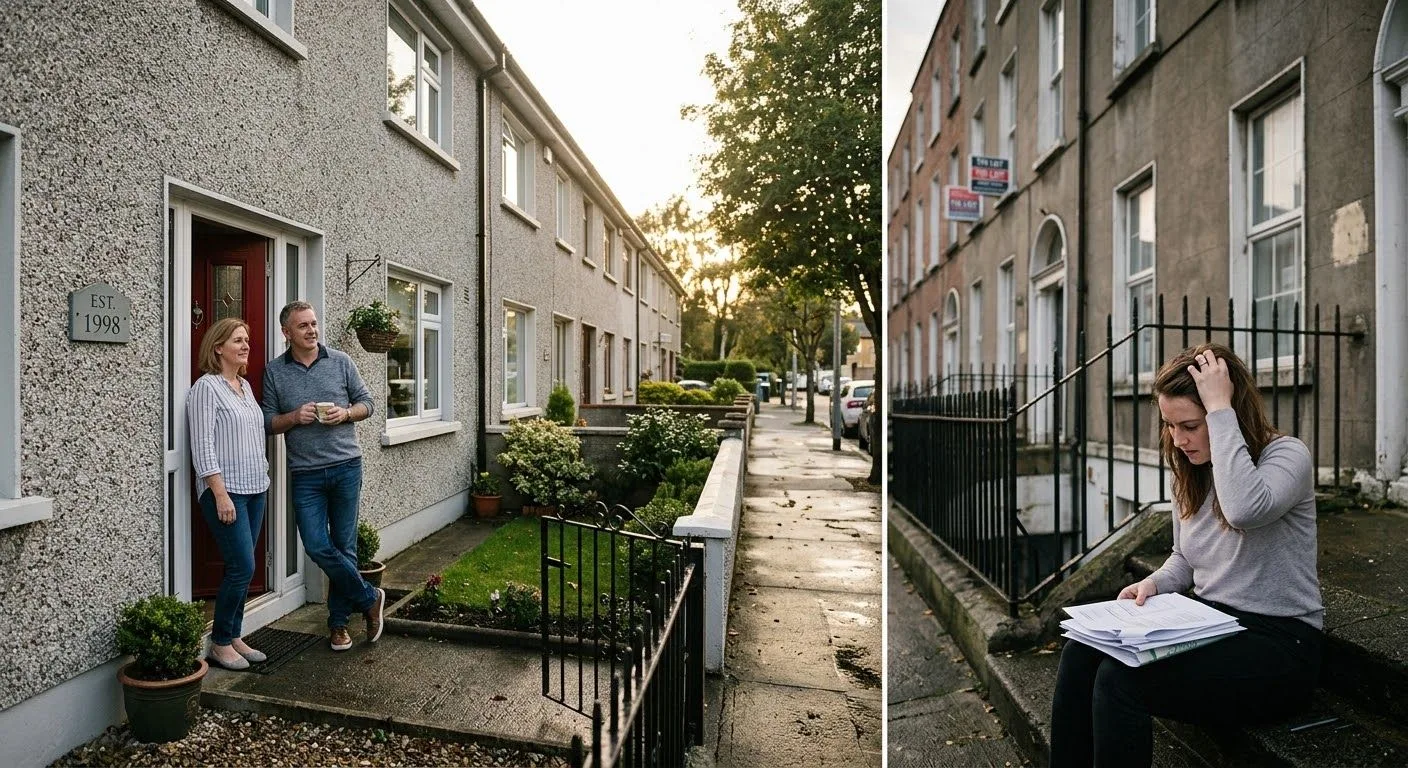
Around 17.1% of people in Ireland at risk of poverty lived in households spending more than 40% of their disposable income on housing in 2025.
Although this was below the EU average, separate Irish statistics show that housing costs remain a significant financial strain for renters and lower-income households.
Ireland recorded a housing cost overburden rate of 17.1% among people at risk of poverty in 2025, compared with an EU average of 29.1%.
The measure identifies people living in households where housing expenses account for more than 40% of disposable income. These expenses include rent or mortgage interest, utilities, maintenance and other housing-related costs.
Housing cost overburden: Ireland and EU
Share of people at risk of poverty living in households spending more than 40% of disposable income on housing. 2025. Source: Eurostat.
Ireland’s rate was 12 percentage points below the European average. However, this does not mean housing is affordable for everyone in the country. The measure focuses on people already at risk of poverty, and the experience of housing costs differs considerably between renters, homeowners and households receiving housing support.
Greece records the highest rate among countries shown
The European comparison reveals substantial differences between countries.
Greece recorded the highest housing cost overburden rate among people at risk of poverty, at 82.6%. Denmark followed at 59.8%, while Switzerland recorded 56.1%.
Germany’s rate was 35%, above the EU average. Spain recorded 28.3%, France 25.4% and Italy 21.7%. At the other end of the comparison, Cyprus recorded 7.6%.
Selected European country comparisons
Share of people at risk of poverty experiencing housing cost overburden, 2025. Ireland highlighted in orange. Source: Eurostat.
The figures show that the burden is not uniform across Europe. Differences in incomes, rents, housing markets, welfare arrangements and access to affordable accommodation all influence how much households spend on keeping a home.
Irish renters report significant financial pressure
Ireland’s position below the EU average does not mean renters are avoiding housing-cost difficulties.
The Central Statistics Office’s Survey on Income and Living Conditions 2025 found that 35.8% of households living in rented or rent-free accommodation considered their housing costs a heavy financial burden.
The CSO also found that 19.7% of people would have been at risk of poverty after rent and mortgage interest payments were deducted from their income, compared with the standard at-risk-of-poverty rate of 12.6%.
For people living in rented or rent-free accommodation, the proportion at risk of poverty after rent was deducted reached 45.2%.
Housing costs and poverty indicators in Ireland
Selected CSO findings for 2025
35.8%
Renters:
heavy burden
45.2%
Renters:
poverty after rent
26.6%
All households:
heavy burden
The indicators measure different aspects of housing pressure and poverty; they should not be interpreted as one common rate. Source: CSO, 2025.
These findings demonstrate how housing expenses can affect the money available for other essentials. A household may be able to meet its rent or mortgage payments but have considerably less left for food, transport, energy and other regular costs.
More than one in four households describe housing costs as a heavy burden
The CSO found that 26.6% of all Irish households considered their housing costs a heavy financial burden in 2025.
Although this was down from 29.5% in 2024, it remained higher than the 23.1% recorded in 2021.
The pressure was particularly pronounced among certain household types. Single-parent households with children were among those reporting the greatest financial strain, with 55% considering housing costs a heavy burden.
Among households experiencing enforced deprivation, 72.4% reported that housing costs represented a heavy financial burden.
These findings underline why national and European averages need to be considered alongside the circumstances of particular groups.
Why the European comparison needs context
The housing cost overburden rate provides a useful way of comparing the share of disposable income spent on housing. However, it cannot capture every aspect of housing affordability.
Two households spending the same percentage of their income on accommodation may have very different amounts remaining after paying their housing expenses.
Tenure also matters. Private renters, social housing tenants and homeowners with mortgages face different costs and financial risks. Their access to housing support and the security of their accommodation can also vary.
For Ireland, the CSO’s findings on poverty after housing payments provide an additional perspective. They show that rent can substantially increase the proportion of people whose remaining income falls below the poverty threshold.
Housing affordability remains a wider challenge
The European figures show that housing costs place a disproportionate burden on people with limited financial resources.
Ireland’s 17.1% rate was below the EU average, but the CSO’s separate findings show that a substantial proportion of renters and lower-income households continue to experience financial pressure.
The European comparison should therefore not be treated as a complete assessment of Ireland’s housing affordability position.
For households struggling with rent, mortgage payments, energy bills and other essential costs, the money remaining after housing expenses may matter as much as the headline percentage used in international comparisons.
The figures provide an important insight into housing affordability across Europe, but they also highlight the need to look beyond national averages when assessing the financial pressure facing households in Ireland.
Sources: Eurostat, 2025 Housing Cost Overburden data; Central Statistics Office, Survey on Income and Living Conditions 2025.
