


House Prices Climb Sharply Across the EU
House prices across the European Union surged by 5.5% in the third quarter of 2025, according to new data released by Eurostat.
The latest figures highlight renewed pressure on households already stretched by a decade of rising property values across the bloc.
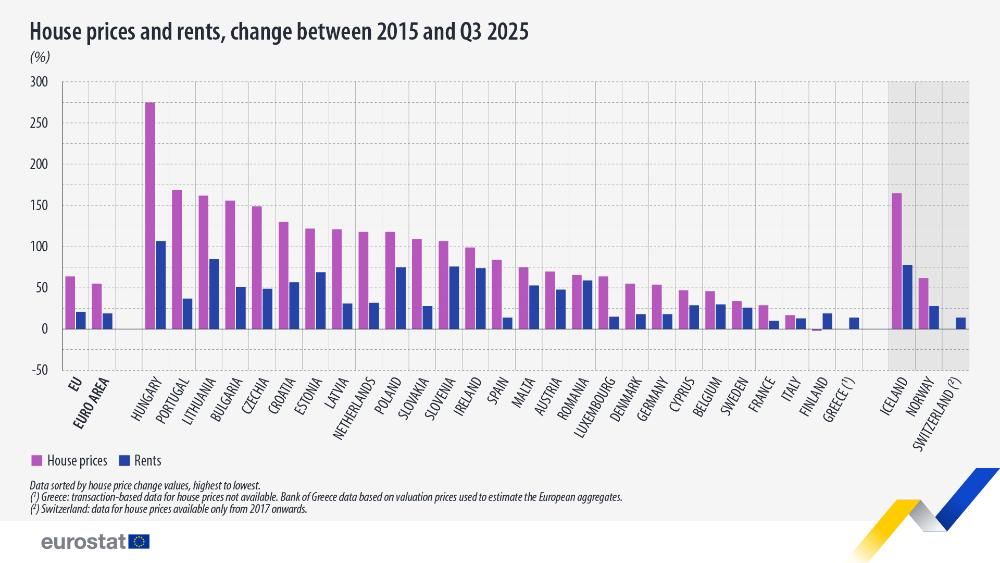
Rents also increased, climbing by 3.1% compared to the same period in 2024. While less dramatic than the rise in house prices, rental increases continue a steady upward trajectory that has persisted for over ten years.
Source datasets: prc_hpi_a, prc_hpi_q, prc_hicp_aind, prc_hicp_midx
Quarter-on-quarter comparisons underline the momentum. Between Q2 and Q3 of 2025, house prices rose by 1.6% and rents by 0.9%, indicating widespread demand and ongoing supply constraints in most EU markets.
The Eurostat release offers a granular snapshot of housing trends that have shifted significantly since the early 2010s. While rents have marched upward consistently, house prices have moved through cycles of stagnation, decline and rapid acceleration.
From 2015 to Q3 2025, EU house prices increased by a striking 63.6%, outpacing income growth in most countries and deepening concerns about long-term affordability.
A Decade of Divergence Between Prices and Rents
Over the same ten-year period, rents rose by 21.1% across the EU, a considerable increase, but one that pales in comparison to the dramatic jump in house prices. This widening gap underscores a structural affordability divide that has become harder for policymakers to ignore.
Eurostat’s long-term charts show that house prices and rents moved in tandem until around 2011, after which the two indicators split sharply. House prices began fluctuating in line with market cycles, while rents continued their steady climb.
Housing economists say this divergence reflects investor activity, supply shortages and shifting demographic patterns that have reshaped demand in urban centres. The result is a market where renting is increasingly expensive, but buying has become even more unattainable for many households.
The new data will add pressure on national governments to address widening affordability gaps as the EU enters another year of housing instability.
Huge National Variations as Hungary Leads Europe in Price Growth
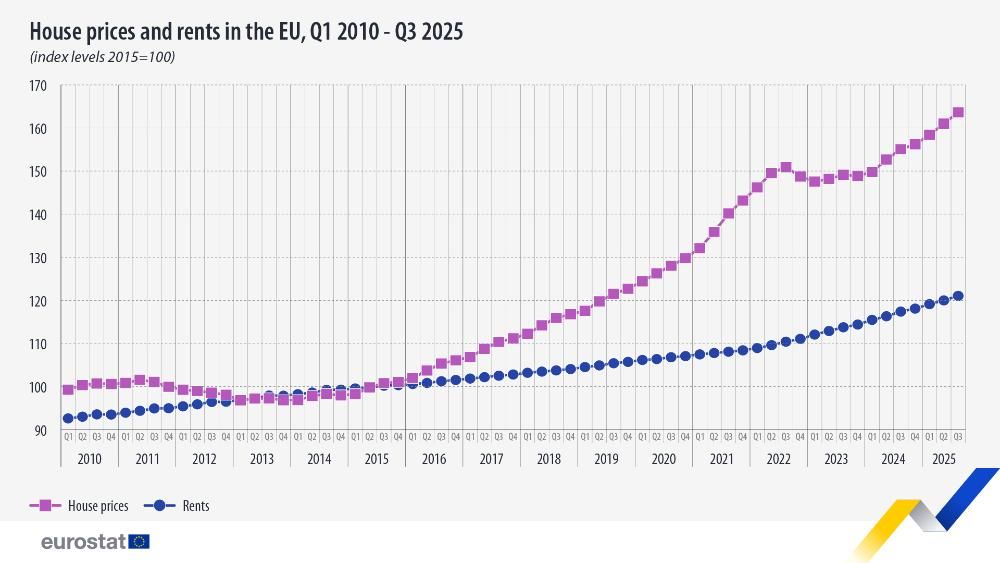
The Eurostat breakdown shows enormous variation across member states. When comparing Q3 2025 with 2015, house prices rose faster than rents in 25 countries, with only Finland recording a modest decline of 2%.
Hungary posted the most dramatic increase, with property values soaring by 275%—a jump that signals a dramatic restructuring of the country’s housing market. Portugal followed with a 169% rise, while Lithuania and Bulgaria saw increases of 162% and 156% respectively.
These sharp escalations reflect a mix of investment trends, foreign acquisitions, and limited construction, all contributing to acute pressure on entry-level buyers.
Source datasets: prc_hpi_q and prc_hicp_midx
Rents also climbed across every EU country. Hungary again topped the list with a rise of 107%, marking the only instance in which rents doubled over the decade.
Behind Hungary, Lithuania, Slovenia, Poland and Ireland recorded some of the highest rental increases, with Ireland experiencing a 74% rise between 2015 and Q3 2025.
Affordability Crisis Deepens as Governments Face Long-Term Challenge
The consistency of rental inflation across the EU highlights a deepening affordability issue that impacts workers, students and families across all income brackets. Eurostat notes that rents have risen steadily even during periods of economic uncertainty, reflecting persistent demand in both urban and regional markets.
The long-term increases have fuelled a growing divide between renters and homeowners, with younger households disproportionately locked out of ownership opportunities.
Economic analysts say the latest figures reinforce warnings from national housing institutes, including Ireland’s ESRI, that the supply of affordable homes remains far below what is needed to keep pace with population growth and urbanisation.
Governments across the EU have ramped up policy interventions, introducing rent caps, subsidy schemes and construction incentives. But Eurostat’s 2025 dataset suggests these measures have not significantly slowed long-term pricing trends.
As policymakers prepare housing strategies for 2026 and beyond, the new figures provide a stark reminder that Europe’s affordability crisis is increasingly structural rather than cyclical.
“Read more about the broader situation in Ireland’s housing market in our Housing Crisis hub here.”
housing-crisis
© 2026 M10News.
