


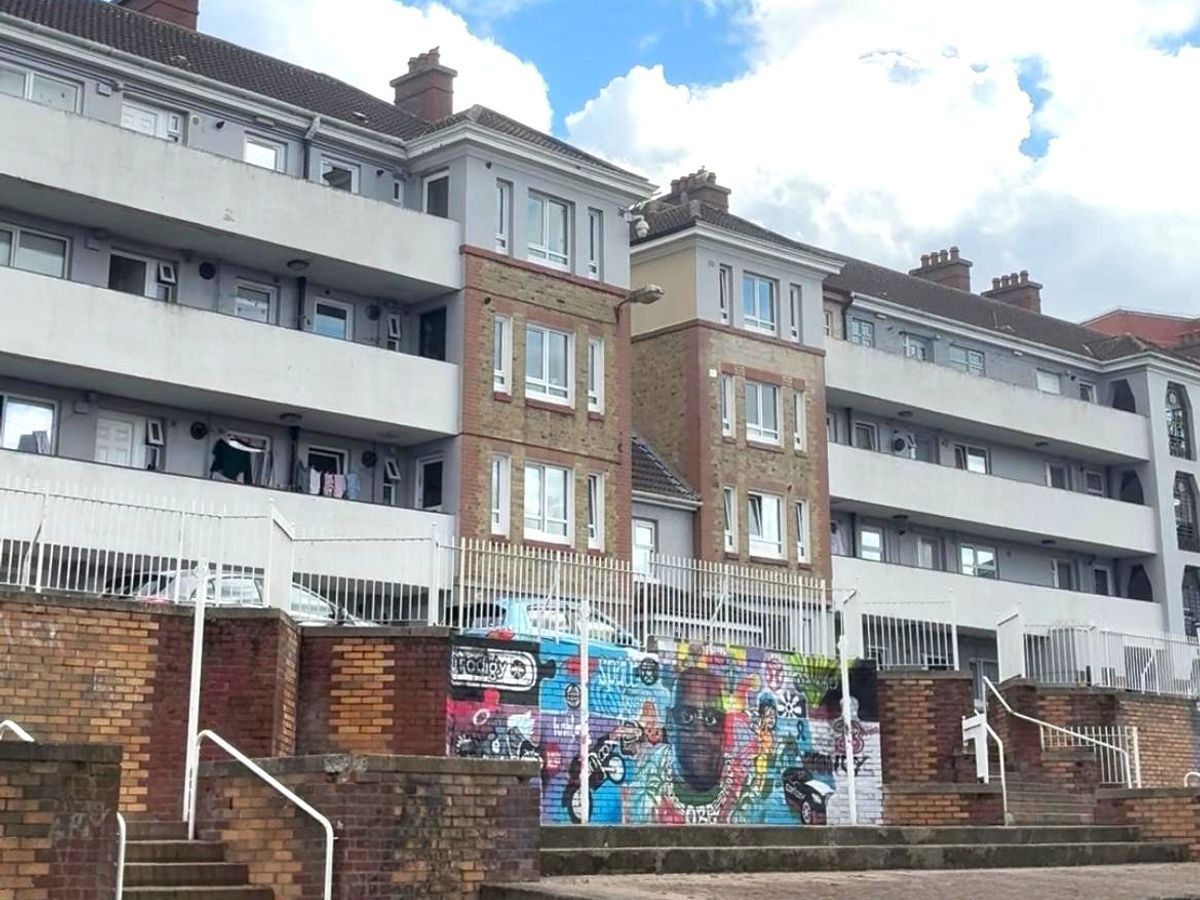
DUBLIN — Dublin City Council tenants living in some of the capital’s older housing stock are facing a difficult contrast: while new social homes are being planned and built nearby, some existing residents say they are still waiting for basic repairs to their homes.
In Darndale, Charlene Paget says she has spent years asking the council to address problems with the windows, gutters and back door of the home where she is raising her four children.
Just across from her home is the so-called Spine Site, a large area of land where Dublin City Council is progressing plans for 84 new social homes for older people, comprising 50 apartments and 34 houses.
The planned development highlights the scale of Dublin’s need for additional social housing. But for tenants already living in council homes, it also raises another question: how quickly can the city improve the condition of the homes it already owns?
Paget says she has been waiting for repairs since moving into her council home around four years ago.
She says the windows remain difficult to open, while a damaged back door allows rainwater into the kitchen. She also says broken gutters have remained unrepaired for a prolonged period.
For tenants experiencing problems such as these, the construction of new homes can be difficult to separate from the condition of their existing accommodation.
84 new homes planned for Darndale
The Darndale Spine Site is planned as a new social-housing development aimed at older people.
The scheme is intended to provide a mixture of apartments and houses, adding 84 social homes to the area.
The development forms part of the wider effort by Dublin City Council to increase the supply of social housing as demand for accommodation remains high.
But the development is taking place alongside longstanding concerns about the condition of parts of the council’s existing housing stock.
Dublin City Council manages more than 29,000 social homes across the city. The council acknowledges that much of this stock is older, with more than 80% of its homes having been built before 1992.
That age profile creates a substantial maintenance requirement, particularly where homes need improvements to windows, doors, roofs, heating systems, insulation and energy efficiency.
The council’s own explanation of the 2026 Differential Rent Scheme says the additional income generated by the changes is intended to help address precisely these issues.
Why Dublin City Council increased rents
Dublin City Council introduced its revised Differential Rent Scheme on 6 April 2026.
Under the new system, the principal earner in a household is charged 18% of assessable income above the relevant €55 threshold, compared with 15% under the previous arrangement. The maximum contribution from subsidiary earners also increased from €21 to €40 per week.
The council has argued that the previous rent structure was no longer sufficient to support the cost of managing and maintaining its housing stock.
According to the council, the revised scheme is expected to generate approximately €33 million in additional income over a full year.
That money is intended to support improvements to existing council homes, including energy-efficiency upgrades, boiler replacements, improvements to flat complexes and communal areas, and the replacement of windows, doors and roofs.
The council’s adopted 2026 budget also stated that the additional income would be used to fund housing planned maintenance and upgrades to existing homes.
For tenants waiting for repairs, however, the issue is not simply whether additional money has been allocated. It is whether that spending results in repairs being completed in individual homes within a reasonable timeframe.
Maintenance spending is increasing
Dublin City Council says it is increasing the amount being spent on planned maintenance.
A written response from the council’s chief executive, cited at the council’s September meeting, put planned-maintenance spending for 2026 at approximately €48.3 million, an increase of €11.2 million compared with the €37.1 million budget available in 2025.
The figure illustrates the scale of the challenge facing the local authority.
The council is not only responsible for constructing new homes. It must also maintain thousands of existing properties, deal with repairs, upgrade older buildings and carry out larger regeneration projects.
Those responsibilities come at a time when the age of much of the housing stock means that maintenance requirements are unlikely to disappear.
Dublin City Council says the new rent scheme is intended to provide a more sustainable source of income for that work.
Rising arrears add another pressure
At the same time, the rent increase has generated concern among councillors and tenants about affordability.
Figures presented to Dublin City Council showed net rent arrears at approximately €35.4 million in March, before the revised rent scheme took effect.
The balance subsequently increased each month through July, reaching approximately €38.1 million.
Rising arrears do not by themselves establish why individual households fell behind on their rent. However, the figures have become part of the wider debate over whether the revised rent system is placing additional pressure on some households.
The council’s scheme includes measures intended to reduce the impact on lower-income households, including a higher amount of income that is disregarded when calculating rent and increased deductions for dependent children. It also provides for a hardship arrangement where tenants cannot afford their assessed rent.
Nevertheless, councillors have continued to question whether the increase should remain in place.
Councillors divided over the rent increase
The debate has produced different views within Dublin City Council.
Supporters of the increase have argued that the additional income is necessary because the existing rental income was not sufficient to maintain the council’s housing stock properly.
At the September council meeting, Green Party Councillor Michael Pidgeon said he supported the increase because of the connection he sees between inadequate maintenance funding and the condition of council housing.
Other councillors have argued that tenants should not be asked to pay more while some are already living in homes where repairs remain outstanding.
People Before Profit Councillor Conor Reddy sought details from the council on how the additional revenue generated by the revised scheme had been spent and how it would be used during the remainder of 2026.
A motion calling for the rent increases to be reversed was subsequently supported by councillors on the council’s housing committee.
Supporters of reversing the increase have pointed to the cost pressures facing households, including tenants living in overcrowded homes or waiting for maintenance.
The disagreement therefore goes beyond the question of whether council rents should be higher or lower.
At its centre is a question about how social housing should be funded and how quickly tenants should see the benefit of additional resources.
New homes and existing homes are both part of the problem
Dublin’s housing shortage means that the city needs additional social housing.
New developments such as the Darndale Spine Site can provide homes for people who would otherwise remain on housing waiting lists or require other forms of housing support.
The council is also progressing major regeneration projects elsewhere.
For example, the redevelopment of Cromcastle Court and the Old Coalyard in Coolock is expected to deliver 152 new social homes, while demolition works are already under way.
At Cherry Orchard Point, Dublin City Council and the Land Development Agency are progressing a development that is ultimately intended to deliver more than 1,200 homes, including social and cost-rental housing.
These projects demonstrate the scale of construction taking place across the city.
But construction does not remove the need to maintain the homes already occupied by council tenants.
For a household living with a faulty window, damp, water penetration or another unresolved repair, the announcement of another housing development several streets away does not solve the immediate problem.
That is why the debate over Dublin’s housing programme increasingly involves two separate but connected questions: how many new homes are being delivered, and what condition are the homes already in?
The challenge of an ageing housing stock
The condition of older council homes is likely to remain an issue even as new developments are completed.
Dublin City Council says that more than 29,000 social homes are under its management and that many are more than 55 years old. The council has therefore framed the rent changes as part of a longer-term attempt to create a more sustainable funding model for maintenance and improvement.
The difficulty is that maintenance needs can be immediate while investment programmes operate over much longer periods.
A tenant who has been waiting for a repair for several years is unlikely to regard a larger future maintenance budget as a solution unless that budget translates into action at their property.
That gap between planned investment and the experience of individual tenants is therefore likely to remain an important measure of whether the revised funding model is working.
What happens next?
Dublin City Council now faces pressure on several fronts.
It must continue increasing the supply of social housing, while also maintaining and upgrading the homes already in its ownership.
It must collect enough rental income to support those responsibilities without placing unsustainable pressure on households.
And it must demonstrate to tenants and councillors that the additional revenue generated by the 2026 rent changes is producing visible improvements to existing housing.
The council’s €48.3 million planned-maintenance programme represents a significant increase in spending. Its revised Differential Rent Scheme is also designed to provide an additional €33 million a year once operating over a full 12-month period.
The test for many existing tenants, however, will be much more straightforward.
For households waiting for windows, doors, roofs, heating systems or other repairs, the question will be whether the additional investment reaches their homes — and how long they have to wait.
Dublin needs more social homes, but the experience of existing council tenants shows that increasing the housing stock and maintaining the homes already available are two sides of the same housing challenge.
