


Rents in Romania and Croatia recorded the European Union’s sharpest annual increases in the second quarter of 2026, with prices rising by 43.5% and 40.1% respectively. The figures stand far above the EU average and raise questions about public housing policies, property investment and the shortage of affordable rental accommodation.
Rental payments across the EU increased by 3% between the second quarters of 2025 and 2026, according to Eurostat figures reported by Euronews Business on 12 October 2026.
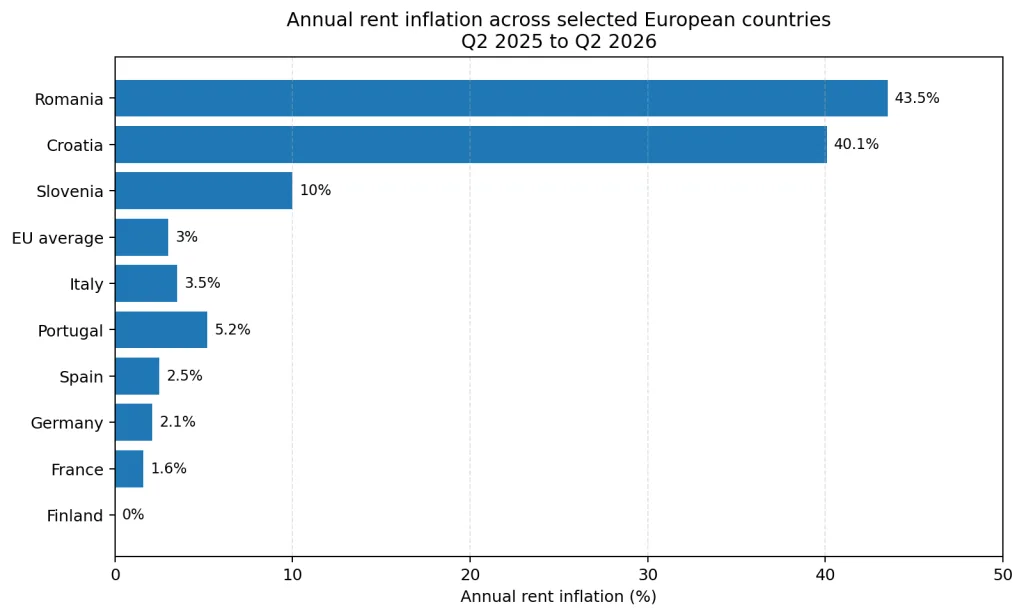
The increase was uneven across the bloc. Finland recorded no annual increase in the comparison, while Romania and Croatia experienced exceptionally large movements. Slovenia followed with a 10% increase, the third-highest among EU countries.
The figures illustrate the different pressures affecting national rental markets, but they do not mean that every tenant in Romania or Croatia experienced an increase of the same size. National rent indices can also be influenced by changes in the types of properties being rented and how rents are recorded.
Rent inflation across the European Union
Romania’s 43.5% increase was accompanied by overall inflation of 9.5% over the same period. Croatia recorded rent inflation of 40.1%, compared with general inflation of 4.8%.
After adjusting for overall inflation, rents increased by more than 30% in both countries. Slovenia’s rent increase was just over 6% in real terms.
These comparisons matter because nominal rent inflation measures the change in rental prices, while real rent inflation accounts for the wider increase in consumer prices. Neither measure alone reveals how affordable housing is relative to local wages or how much households spend on rent.
Chart 1: Annual rent inflation in selected EU countries
The following original M10news chart uses the reported year-on-year figures for the second quarter of 2026.
Romania: Disagreement over the reasons for rising rents
Romanian authorities attributed the increase partly to higher administered rents for properties owned by the state or local authorities.
However, Dr Adriana M. Soaita of the University of Glasgow questioned whether public housing rents could explain such a large increase in the national figures.
She argued that public rental housing accounts for too small a share of Romania’s overall housing stock to have a substantial effect on the national average, particularly because rents in that sector are considerably lower than those in the private market.
Soaita suggested that newly built or extensively renovated properties entering the rental market could be contributing to the reported increase. Such homes may command rents substantially above the previous average.
Her explanation highlights an important statistical consideration: changes in the mix of properties available for rent can affect a national index, even when the experience of individual tenants varies considerably.
The available explanations do not establish a single, definitive cause for Romania’s unusually high increase.
Croatia: Social rents, investment properties and vacant homes
In Croatia, the institution supplying the data attributed the sharp increase partly to a decision by Zagreb’s local authorities to raise rents for certain categories of social housing.
Professor Gojko Bezovan of the University of Zagreb identified another factor: the growing role of residential property as an investment, particularly in apartments and tourism-related real estate.
He argued that a significant proportion of apartments in new developments are purchased as investments rather than to provide permanent homes, with some properties remaining vacant.
Croatia introduced a tax on vacant residential properties in 2025. Bezovan also pointed to a substantial increase in residential rental contracts registered with the Tax Administration during 2025 and 2026.
He suggested that more higher-quality properties had subsequently entered the formal rental market, often at prices above the previous average.
This is one possible explanation for the sharp movement in the index, rather than evidence that every Croatian tenant faced a 40.1% rent increase.
Turkey records an even higher increase outside the EU
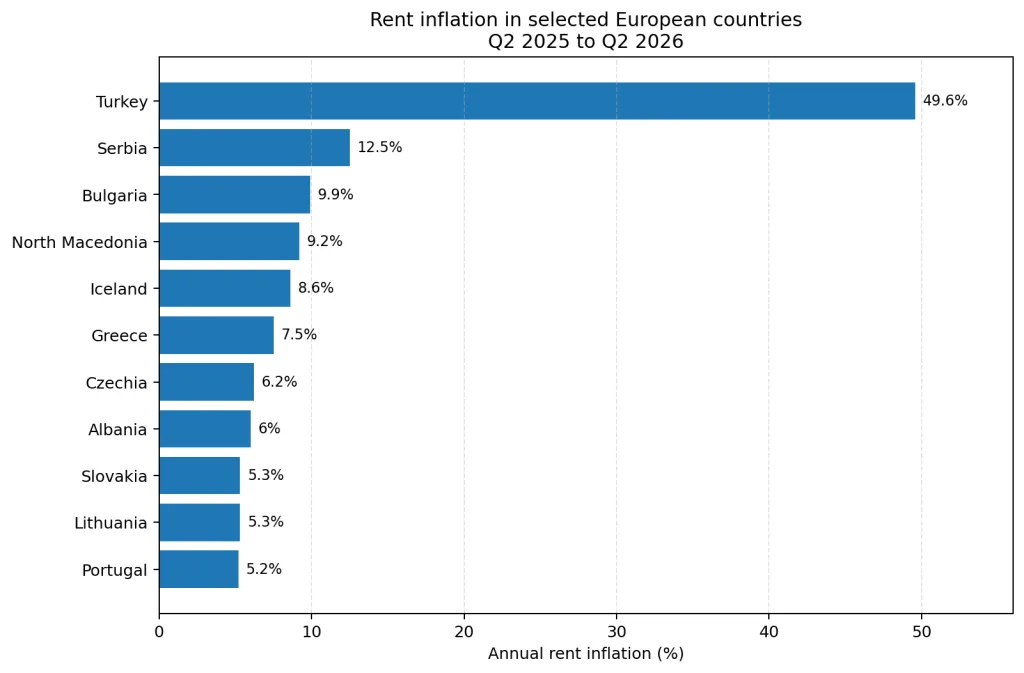
When EU candidate countries and members of the European Free Trade Association are included, Turkey recorded the highest annual rent inflation in the comparison, at 49.6% between the second quarters of 2025 and 2026.
However, Turkey’s pattern differed from those of Romania and Croatia. Its rents had been rising more gradually, while overall inflation exceeded 30% over the same period. After accounting for general inflation, the real increase was therefore much smaller than the figures in Romania and Croatia.
Serbia recorded a 12.5% annual increase, while Bulgaria’s rate was 9.9%.
Other countries with increases above 5% included:
- North Macedonia: 9.2%
- Iceland: 8.6%
- Greece: 7.5%
- Czechia: 6.2%
- Albania: 6%
- Slovakia: 5.3%
- Lithuania: 5.3%
- Portugal: 5.2%
These figures cover a wider group of European countries and should not be confused with the EU-only comparison.
Chart 2: Rent inflation across a wider group of European countries
How rents changed in Europe’s largest economies
Among the EU’s four largest economies, Italy was the only country to record rent inflation above the EU average, at 3.5%.
Spain recorded an increase of 2.5%, Germany 2.1% and France 1.6%.
Belgium, Estonia, Finland and Luxembourg recorded no increase in rents in real terms after accounting for overall inflation. This does not necessarily mean that nominal rents were unchanged in those countries.
The differences underline why rental affordability cannot be assessed through inflation rates alone. Income levels, the availability of long-term rental homes and the share of household income devoted to housing also matter.
August figures reveal a different picture for Croatia
Eurostat’s August 2026 figures showed EU rents rising by 2.9% compared with August 2025, broadly consistent with the second-quarter trend.
Croatia, however, recorded an annual increase of just 4.3% in August, substantially below its 40.1% second-quarter comparison.
Euronews reported that this difference was affected by a sharp jump in the Croatian rent index between July and August 2025. That unusual movement influenced the subsequent year-on-year and quarterly comparisons.
The August figure should therefore be presented separately from the second-quarter result. The two rates cover different comparison periods and should not be treated as interchangeable measures.
Competition for limited rental homes pushes up new-lease prices
Beyond national policies and statistical effects, housing researchers and market analysts point to the imbalance between demand for rental accommodation and the supply available in many European cities.
Emma Rosser, EMEA living research director at JLL, told Euronews Business that rental growth for new tenancies appeared elevated and was accelerating, even where overall figures covering existing rental arrangements did not show similarly sharp increases.
She said strong competition for scarce rental housing was driving price growth for new tenancies, with the pressure particularly pronounced in cities experiencing the strongest increases.
This distinction matters for people entering the market. Existing tenants may remain on older agreements, while people moving home or signing their first rental contract can face the latest asking prices.
Dr Nóra Teller of the Budapest-based Metropolitan Research Institute also identified economic conditions, demographic change and constraints on housing supply as factors behind rising rents.
She explained that a prolonged period of low interest rates had encouraged property borrowing before borrowing costs rose sharply in 2022. Higher costs made buying a home more difficult for some households, pushing additional demand towards private rentals.
Teller also highlighted the financialisation of housing, in which institutional investors, private equity funds, real estate investment trusts and buy-to-let owners treat residential property increasingly as an investment asset.
The importance of these factors differs by country and city. The figures do not establish that one factor alone explains rent inflation across Europe.
What the figures mean for Europe’s housing market
The latest comparison shows that rental inflation across Europe is far from uniform. Romania and Croatia recorded exceptionally high increases in the second quarter of 2026, while several major EU economies experienced much more moderate changes.
Understanding the reasons requires looking beyond headline percentages to the structure of each rental market, the availability of homes, household incomes, public-sector rent decisions and changes in the properties entering the market.
For tenants, the central concern is whether secure, suitable rental homes remain available at prices they can afford. For policymakers, the challenge is to understand the pressures behind local rent increases and determine which measures can improve access to housing without relying on headline inflation figures alone.
