


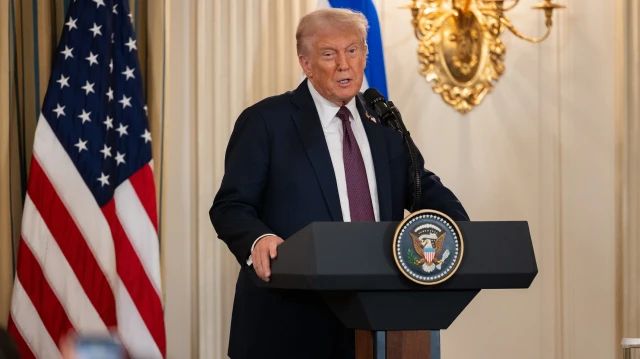
WASHINGTON — President Trump accused Iranian leaders of bad faith on Monday, saying Tehran pushed for negotiations over the weekend only to publicly deny any talks were taking place once a pause in strikes had been secured.
Trump Says Iran Requested Talks, Then Denied Them
In a Truth Social post, Trump said Iranian officials had effectively pleaded for a meeting with the United States, prompting a temporary halt in military action and the scheduling of further discussions.
He said Tehran then reversed course, insisting it was engaging only with Oman and had no ongoing dialogue with Washington. Trump called the shift proof of what he described as Iran’s long pattern of duplicity.
Trump Reasserts US Control of the Strait of Hormuz
Trump dismissed Iranian claims that it would control shipping through the Strait of Hormuz, arguing the waterway is already fully secured by the US Navy. He framed the current posture as a blockade that allows nothing through without American approval, and said Iran faces a choice between a negotiated deal or total surrender. He closed the post with a blunt declaration on the underlying US position: “IRAN WILL NEVER HAVE A NUCLEAR WEAPON!”
Why the Strait of Hormuz Is the Real Flashpoint
The dispute over Trump’s Truth Social post is really a dispute over one waterway. Before the war between the US, Israel and Iran broke out earlier this year, roughly a fifth of the world’s traded oil and natural gas moved through the Strait of Hormuz, making any disruption there a direct driver of global energy prices.
That history helps explain why Trump’s Monday outburst landed the way it did. He has issued similar ultimatums and threats to Iran repeatedly since the conflict began in February, at one point giving Tehran a 48-hour deadline to reopen the strait or face the destruction of its power plants and bridges, only to extend or cancel the threatened strikes days later.
The pattern repeated again this weekend: Trump said he was holding off on a new round of “massive” strikes after Gulf allies indicated a deal to reopen Hormuz was close, then reverted to accusing Iran of bad faith less than 24 hours later.
Talks With Oman, Not Washington, Appear to Be the Active Track
Iranian officials have pushed back hard on Trump’s version of events. Tehran’s foreign ministry says it is not negotiating directly with the United States at all, and that the real diplomatic progress is happening in a separate channel with Oman, which sits across the strait and has been discussing a new managed shipping route through the waterway. Iran’s foreign minister said over the weekend that those Oman-brokered talks were in their final stages.
Markets moved on the diplomatic signals regardless of who Iran says it is actually talking to. Brent crude fell more than 4% on Monday as traders priced in the prospect of Hormuz reopening to normal traffic.
Analysts remain split on how close a durable resolution actually is. Some Middle East specialists have voiced scepticism that Trump’s repeated cycle of threats and reversals reflects real progress, while risk consultancy BMI said this week that a broader diplomatic understanding on the strait is still achievable this quarter, even as it raised the odds of renewed escalation.
The remarks come as the administration continues to frame its Iran policy around denying Tehran any nuclear weapons capability, even as the two sides offer conflicting accounts of whether direct US-Iran talks are actually underway.
M10News has been reporting on Trump pausing Iran strikes to allow diplomatic talks to progress, on Trump warning Putin and Xi not to assist Iranian forces and on how the Iran conflict is driving up construction costs and worsening Ireland’s housing crisis.
Editing by M10News News Desk | © 2026 M10News. All rights reserved. Unauthorised reproduction is prohibited.
